
Views: 0 Author: ShangKun Publish Time: 2026-09-03 Origin: Site
A compression latch is one of the most important fasteners in industrial equipment — and one of the most misunderstood. Unlike a simple draw latch, a compression latch pulls a door or panel tightly against its gasket, creating a consistent seal that keeps out dust, moisture and pressure. From outdoor electrical enclosures to medical test chambers, the right compression latch can be the difference between equipment that lasts and equipment that fails. This guide explains what a compression latch is, how it works, the main types, materials, and how to choose the right one for your application.
Not sure which compression latch fits your door? Our engineers reply within 24 hours with a free recommendation.
Contact Us for a Quote Email Us
A compression latch is a mechanical fastener that compresses a door or panel against a seal when closed. As you turn the handle, a cam rotates and draws the door inward, squeezing the gasket between the door and the frame. The result is a controlled, repeatable sealing force — not just "closed", but sealed.
That compression matters more than most engineers expect:
Gasket longevity — even compression prevents over-tightening one corner while under-sealing another.
Vibration resistance — a compressed latch has no play, so it will not rattle loose on machines, vehicles or outdoor equipment.
Environmental protection — consistent gasket contact is what actually delivers the IP rating printed on the enclosure.
Common applications include outdoor enclosures, electrical and telecom cabinets, environmental test chambers, medical and IVD equipment, cleanroom panels and refrigeration units.
The working principle is simple: rotate, engage, compress.
Rotate — turning the handle or key rotates the cam into the strike plate.
Engage — the mechanism clicks past its over-centre point and locks in position.
Compress — the cam's curved profile pulls the door inward and holds the gasket under even pressure.
Many KUNLONG compression latches — such as the SK1-606 compression handle and SK1-701-X compression latch — also offer adjustable compression depth, so the seal force can be fine-tuned on site. That is especially useful when gaskets are replaced or doors need re-fitting after years of service.
Type | Typical Use | KUNLONG Model |
|---|---|---|
Paddle / flush compression latch | Medical equipment, test chambers, cleanroom panels — flush surface, easy to clean | SK1-701-X, SK1-0008-ZN01 |
Compression handle (T-handle style) | Tool-free fast access — ovens, biological equipment, testing equipment | SK1-606 |
Key-locking compression latch | Security + sealing — 5G cabinets, outdoor telecom, anti-tamper enclosures | SK1-504R, SK1-706R |
Multi-point compression system | Large doors needing even pressure across the whole seal | Custom (OEM) |
The two are often confused — both turn to lock. The difference is what happens after the latch closes. A cam lock simply rotates a cam against the frame; a compression latch actively pulls the door inward against a gasket.
Feature | Compression Latch | Cam Lock |
|---|---|---|
Door pull-in / gasket compression | Strong — pulls door against the seal | Weak — cam only rotates against the frame |
Sealing (IP rating) | Excellent | Limited |
Vibration resistance | High | Moderate |
Typical use | Test chambers, outdoor cabinets, medical equipment | Electrical cabinets, furniture, light enclosures |
Cost | Higher | Lower |
Rule of thumb: if the enclosure must seal — against dust, water, pressure or contamination — choose a compression latch. If you only need to keep the door shut, a cam lock (panel lock) is enough. Browse the full lock series and draw latch series to compare options.
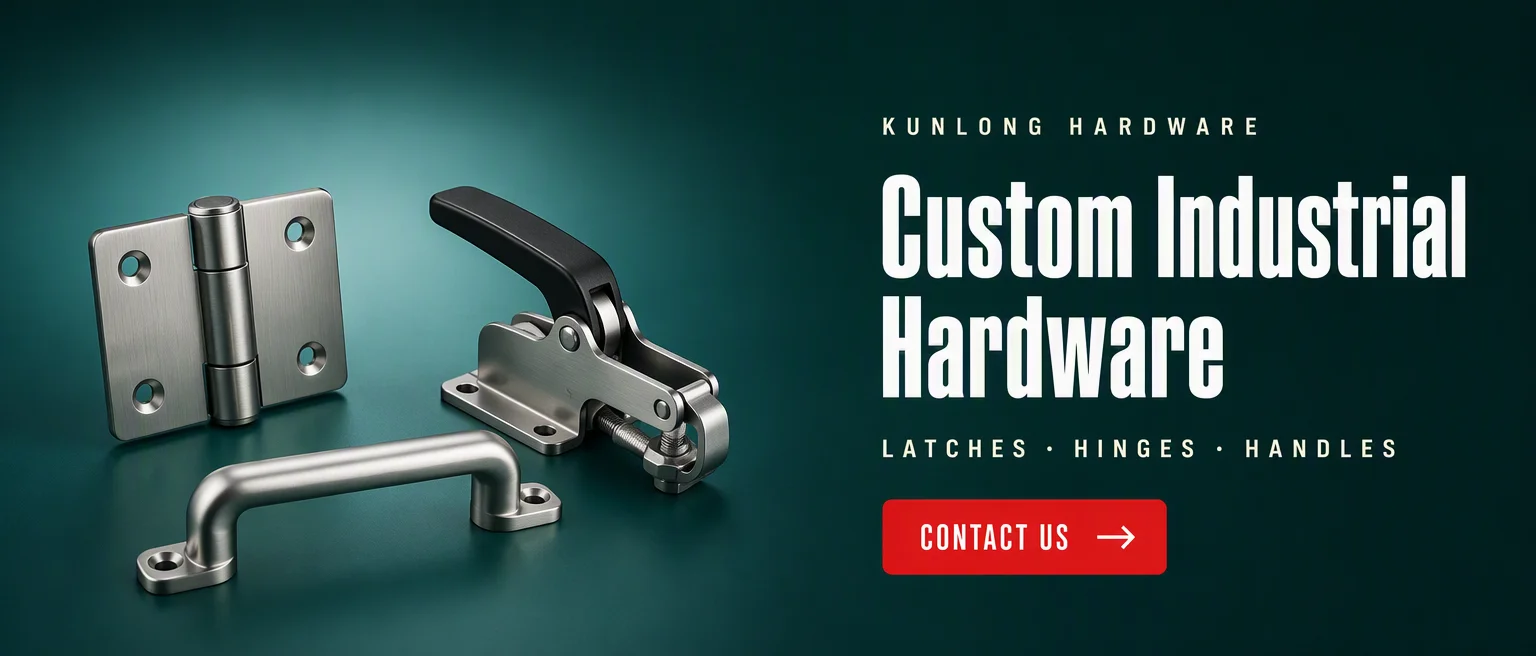
Click the banner or the red button to send us your inquiry →
Corrosion resistance starts with material selection:
304 stainless steel — the workhorse. Suitable for general industrial, indoor and most outdoor use; cost-effective and easy to maintain.
316 stainless steel — adds molybdenum for superior salt-spray and chemical resistance; the choice for marine, coastal, pharmaceutical and harsh chemical environments.
Finishes matter too: brushed stainless, zinc-plated steel and powder-coated finishes each change both price and performance. At KUNLONG, every batch passes a 15-point quality inspection and a 24,000-cycle life test before shipment — so the material and finish you specify is exactly what you receive.
Ask these five questions before specifying:
Must the enclosure seal? Define the IP rating, then pick a latch with real pull-in force. For a compression latch for outdoor enclosure use, choose 316 stainless or powder-coated steel.
How often is it opened? Tool-free handles for frequent access; keyed versions where security matters.
Flush or surface mount? Flush paddle latches suit cleanroom and medical panels; surface mounts are simpler to retrofit.
Any size constraints? Compression latches come in many sizes — KUNLONG also machines custom sizes and mounting patterns (OEM/ODM).
What environment? Temperature, humidity, chemicals and washdown each change the material and finish specification.
ShangKun (KUNLONG) has designed and manufactured industrial structural parts — latches, hinges, handles and leveling feet — for nearly two decades, serving environmental test chambers, biomedical equipment, new energy, semiconductor and telecom industries worldwide.
In-house R&D and tooling, from prototype to mass production
15-point inspection and 24,000-cycle life testing on every batch
OEM/ODM: custom sizes, materials, surface finishes and branding
One-stop supply — lock series, hinge series, draw latch series, leveling feet series
Related reading: Draw Latch Series · Hinge Series · Panel Locks · Heavy-Duty Hinges
A draw latch clamps across a seam with a wire or hook, while a compression latch rotates a cam to pull the door or panel against a gasket. Choose a compression latch when sealing performance matters.
Yes. With 316 stainless steel or powder-coated finishes, compression latches are widely used on outdoor enclosures, 5G cabinets and telecom equipment that must resist rain, dust and corrosion.
Most are stainless steel (304 or 316), zinc-plated steel or aluminium, with plastic or metal handles. Material choice depends on the environment and required corrosion resistance.
Yes. KUNLONG offers OEM/ODM customization — sizes, mounting patterns, materials, surface finishes and branding.
Most models have an adjustable cam or threaded stud. Turn the adjustment to increase or decrease compression force, then re-test the gasket seal on the door.
Send us your door size, gasket type and application — our engineers will recommend the right compression latch, free of charge.
Email: mandy@kunlong.net · Tel: +86-769-27235720
0
DiscardApply
StyleLayout